
Blog
OSHA’s New PPE Fit Requirement
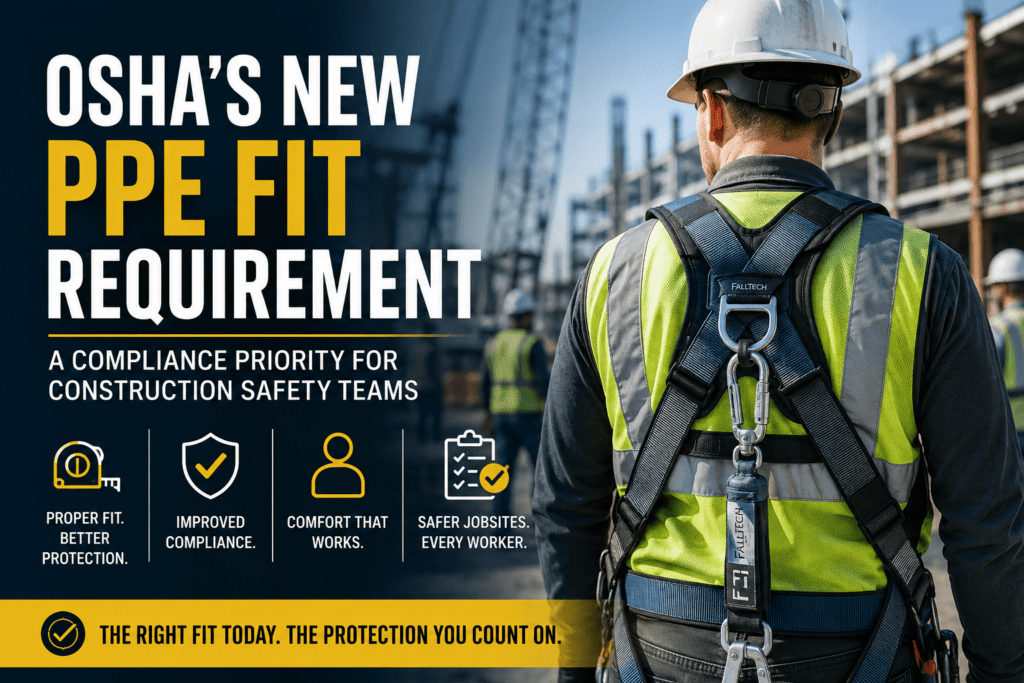
OSHA’s New PPE Fit Requirement:
A Compliance Priority for Construction Safety Teams
Compliments of The Man Store
Personal protective equipment has always been one of the most visible parts of a construction safety program. Hard hats, gloves, safety glasses, high-visibility apparel, respirators, protective footwear, and full-body harnesses are all everyday tools on active jobsites. But OSHA’s latest clarification makes one point unmistakable: PPE is not simply “provided” when it is handed to a worker. It must also **fit that worker properly**.
OSHA’s final rule for construction PPE became effective on **January 13, 2025**, and revised the construction standard at **29 CFR 1926.95(c)** to explicitly require employers to select PPE that properly fits each affected employee. OSHA explains that this update aligns construction more closely with existing PPE language for general industry and shipyards.
For safety professionals, this is more than a paperwork change. It affects purchasing, training, hazard assessments, inspections, documentation, and worker engagement. Most importantly, it reinforces a practical safety truth: equipment that is too big, too small, poorly adjusted, or uncomfortable enough to discourage use may not protect the person wearing it.
What Changed?
The core change is simple. OSHA clarified that construction employers must ensure PPE is both suitable for the work being performed and selected so that it properly fits each affected employee. OSHA has stated that properly fitting PPE was already part of its interpretation of the construction PPE standard, but the final rule makes that requirement clearer and easier to understand.
That clarification matters because construction workforces are not one-size-fits-all. Workers vary in height, weight, body shape, hand size, face shape, and mobility needs. A “standard” size may work for some employees but fail others. OSHA specifically notes that improperly fitting PPE is a significant issue for smaller workers, including some women, who may not be adequately protected by commonly stocked PPE sizes.
This rule does not mean every item of PPE must feel perfectly comfortable. Discomfort alone does not automatically prove a violation. However, discomfort can be a warning sign that the PPE does not fit correctly or is not appropriate for the hazard.
Why Proper Fit Matters

PPE only works when it protects the worker from the hazard it was selected to control. Poor fit can reduce that protection, eliminate it entirely, or even introduce new hazards.
For example, oversized gloves may reduce dexterity and create a caught-in hazard around rotating tools or machinery. Safety glasses that do not seal or sit correctly may allow debris to reach the eyes. Loose high-visibility clothing may snag. Respiratory protection that does not fit the face cannot provide the intended level of protection. Fall protection equipment that is not properly sized and adjusted may fail to distribute arresting forces correctly during a fall.
These concerns are not theoretical. Improperly fitting PPE may fail to protect employees, reduce the level of protection, create additional hazards, or discourage workers from using the equipment at all.
That last point is especially important for safety culture. When workers believe their gear is uncomfortable, ineffective, or not made for them, they are more likely to alter it, remove it, wear it incorrectly, or avoid using it whenever supervision is not present. A proper-fit program helps remove that friction.
Why Harness Fit Deserves Special Attention
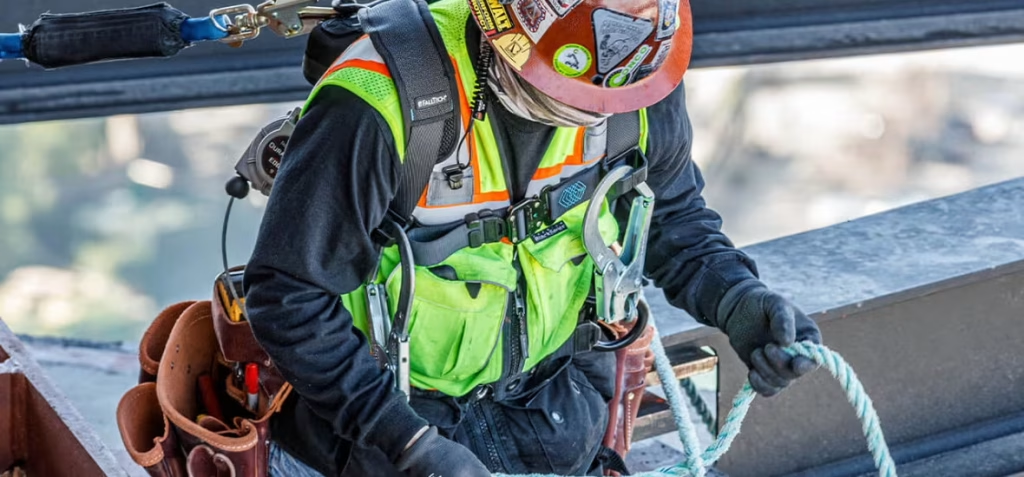
Full-body harnesses deserve particular focus because they are used in high-consequence situations. When a fall occurs, the harness becomes part of a personal fall arrest system. If the harness is too loose, incorrectly adjusted, or the wrong size, it may not keep the worker properly positioned during fall arrest. If it is too tight or poorly configured, it may cause pressure, restrict movement, or contribute to injury during suspension.
A harness should be selected according to the manufacturer’s sizing guidance and adjusted so the dorsal D-ring is properly positioned, straps lie flat, leg straps are secure, and the chest strap is correctly located. Workers should be trained not only to put on the harness but also to recognize when it does not fit their body correctly.
Safety professionals should avoid treating harness fit checks as a formality. A visual inspection can confirm condition, but it does not always confirm fit. Supervisors and competent persons should verify that each worker can adjust the harness correctly while wearing normal work clothing and tools. Seasonal clothing changes also matter. A harness that fits over a light shirt in summer may need adjustment or reassessment when worn over insulated winter layers.
What Safety Professionals Should Do Now
A practical response starts with the PPE hazard assessment. Employers should review the PPE required for each task, then confirm whether the available sizes and styles actually fit the employees expected to use them. This review should include both standard PPE and specialized equipment such as fall protection, cut-resistant gloves, eye protection, hearing protection, respiratory protection, arc-rated clothing, chemical-resistant gear, and protective footwear.
Next, safety teams should evaluate purchasing practices. Many companies buy PPE in bulk based on what is cheapest or most commonly available. That approach can leave workers with limited size options. A better process includes multiple sizes, alternative cuts or styles, and access to vendors that can supply PPE for a broader range of body types.
Training should also be updated. Workers need to know how PPE should fit, how to adjust it, when to request a different size, and why modifying PPE can create hazards. Supervisors need to know how to respond when workers report that equipment does not fit. A worker should not be treated as difficult because standard-issue PPE does not work for them.
Documentation can help demonstrate compliance. Safety managers should consider maintaining records of PPE assessments, size availability, worker training, fit checks for critical equipment, and corrective actions when fit problems are identified. OSHA says enforcement will rely on existing guidance, consensus standards, and manufacturer instructions to determine whether PPE fits properly.
Common Mistakes to Avoid
One common mistake is assuming that “available” means “compliant.” A box of gloves, glasses, or harnesses in the trailer does not solve the problem if the available sizes do not fit the crew.
Another mistake is relying only on unisex or universal PPE. Some universal products work well, but others create gaps for workers outside average sizing assumptions. Employers should evaluate performance and fit, not just the label on the packaging.
A third mistake is ignoring worker feedback. Employees often know immediately when equipment is too loose, too tight, unstable, or interfering with the task. Reports of poor fit should be treated as safety information, not complaints.
Finally, safety teams should avoid waiting for an incident or inspection to discover fit problems. Proactive fit reviews are easier, less expensive, and more defensible than reactive corrections after a near miss, injury, or citation.
The Bigger Impact
OSHA’s proper-fitting PPE rule is also about workforce inclusion. Construction companies are trying to recruit and retain workers from a broader labor pool. When PPE is only stocked for a narrow range of body types, some workers receive a clear message that the jobsite was not designed with them in mind. Properly fitting PPE helps protect workers physically while also supporting professionalism, morale, and retention.
The rule also gives safety professionals a stronger basis for improving procurement and inventory decisions. Instead of asking for “extra” options, safety leaders can point to a clear regulatory requirement: PPE must fit properly. That makes it easier to justify better vendor relationships, expanded size ranges, additional training, and more structured inspection practices.
Final Takeaway
The OSHA update should not be viewed as a minor wording change. It is a reminder that PPE must work for the person wearing it. For construction employers, compliance now requires a more intentional approach to selecting, issuing, training on, and inspecting protective equipment.
Proper fit is not a preference. It is part of protection. When PPE fits correctly, workers are more likely to wear it, use it correctly, and receive the protection the equipment was designed to provide. For safety professionals, the path forward is clear: assess the hazards, evaluate the workforce, stock appropriate options, train workers thoroughly, and document the process. That approach supports compliance, reduces risk, and helps build safer jobsites for every worker.
Shop Fall Protection Equipment and Accessories
Visit The Man Store
As OSHA places greater emphasis on properly fitting PPE, now is the right time to review your fall protection inventory and make sure your team has access to the right equipment, sizes, and accessories for the job.
For fall protection equipment and accessories from major manufacturers, including FallTech, visit The Man Store at https://themanstoreonline.com.
You can also shop fall protection equipment and PPE options at The Woman Store at https://thewomanstoreonline.com, with solutions designed to help more workers find protective equipment that fits properly and performs reliably.
Whether you are updating your safety program, replacing worn equipment, or expanding PPE options for a diverse workforce, both stores offer practical resources for construction professionals focused on compliance, comfort, and jobsite safety.
