Fall Protection
Fall Protection Kits for Roofers, Contractors, and Industrial Crews
Compliments of The Man Store
In the construction and maintenance sectors, working at heights is one of the main hazards. A fall protection kit bundles the core components of a personal fall arrest system in one purchase, which simplifies buying for roofers, contractors, and industrial crews. A kit is a starting point, not a complete safety plan: the right setup still depends on the job and the employer’s hazard assessment.
What Are Fall Protection Kits?
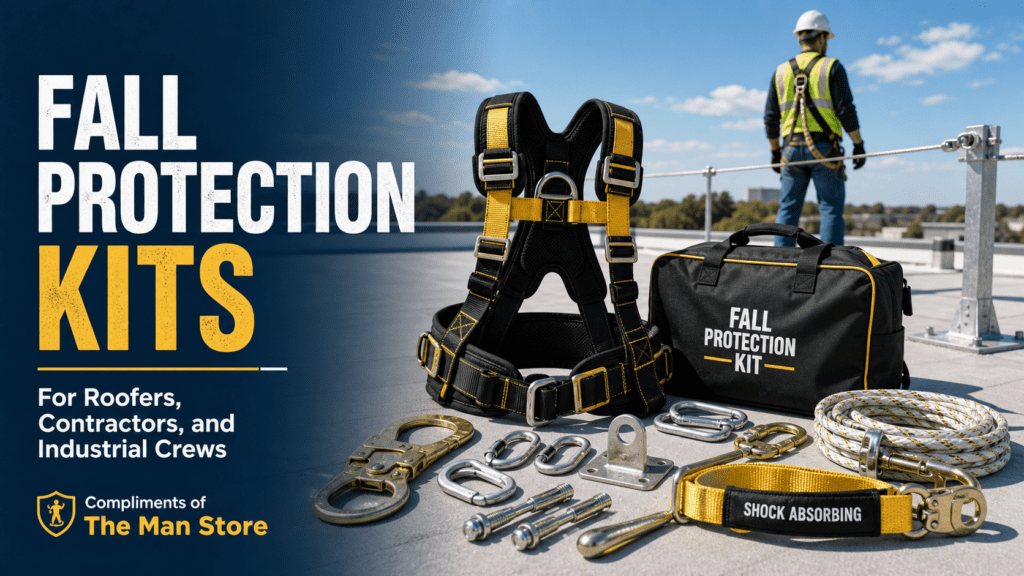
Fall protection kits are comprehensive collections of safety gear designed for working at heights. These kits typically include:
- Harness: A secure harness fits snugly around the body, distributing weight during a fall and preventing injury.
- Lanyard or Lifeline: This connects the harness to an anchor point, providing mobility while ensuring safety.
- Anchor: A reliable anchor point is crucial for attaching the lanyard, making sure the worker is secured at all times.
- Storage Bag: A dedicated bag keeps all components organized, making it easy to transport and store.
The contents of kits vary, so check what is in each one against the work being done. Buying a pre-packaged kit can save time sourcing individual components, but the components still have to be compatible with each other and suitable for the anchor point and the task.
Benefits of Using Pre-Built Fall Protection Kits
For roofers, contractors, and industrial crews, choosing a pre-built fall protection kit offers several advantages:
Simplified Purchasing
Navigating the extensive range of safety equipment can be overwhelming. A pre-built kit eliminates the guesswork, allowing you to acquire a complete set of tools tailored for height safety without the need to build a kit from scratch.
Streamlined Training
Having a standardized kit means that training sessions can be more effective. Teams can familiarize themselves with a consistent set of equipment, which enhances understanding and proper usage.
Improved Safety Compliance
A complete kit can make it easier to assemble matching components, but buying a kit does not by itself make a job compliant. Compliance depends on how the system is rigged, the anchorage, training, inspection and the employer’s fall protection plan.
Ultimately, the selection of fall protection kits should align with your team’s specific job duties, work environments, and safety needs. Factors such as fit, comfort, visibility, and durability play crucial roles in ensuring employee safety and satisfaction.
What to Look For in a Roofer’s Fall Protection Kit
For roofing, a kit is usually built around three parts of a personal fall arrest system: a body harness, an anchorage, and a connecting means such as a lanyard, deceleration device or lifeline. Browse Roofing Kits and Fall Protection Kits, or look at the parts one by one: Safety Harnesses, Lanyards and Anchor Points.
- Anchorage. OSHA’s rules call for an anchorage that can support at least 5,000 pounds for each worker attached; on construction work, OSHA also allows an anchorage designed, installed and used under a qualified person’s supervision as part of a complete system with a safety factor of at least two. A kit’s roof anchor is only part of that; the structure it attaches to matters too.
- Compatible components. The harness, connector and anchor have to work together and meet strength requirements.
- After a fall. Any component that took the impact load comes out of service until a competent person inspects it and decides it is safe to use again.
- Body belts. OSHA prohibits body belts as part of a personal fall arrest system; use a full body harness.
- Height and training. OSHA’s fall protection guidance for construction sets the trigger height at six feet, and employers must train workers on the hazards of the job in a language they understand.
This is educational, not safety or legal advice. What a particular roof job needs depends on the employer’s hazard assessment and the regulator’s own text; OSHA also publishes guidance for fall protection.
FAQ
What types of fall protection kits are available?
Fall protection kits can vary widely based on specific applications, including roofing, construction sites, and maintenance tasks. It’s essential to choose kits suited to your work environment.
How do I determine the right fall protection kit for my crew?
Consider the unique hazards your team faces, the nature of the tasks performed (for example sloped roofing versus work at a leading edge), the anchor points available on site, and individual fit and comfort. If your crew works on roofs, start with Roofing Kits; for other work, see Fall Protection.
Related Workplace Safety Guides
For further reading on workplace safety, consider the following guides:
If you are looking for fall protection kits for your crew, The Man Store carries Fall Protection Kits and Roofing Kits. Explore the selection or contact us today with questions about your application.
